

Malaysia Freight Logistics Market to Grow from USD 33.49 Billion in 2026 to USD 54.30 Billion by 2035 at 5.52% CAGR
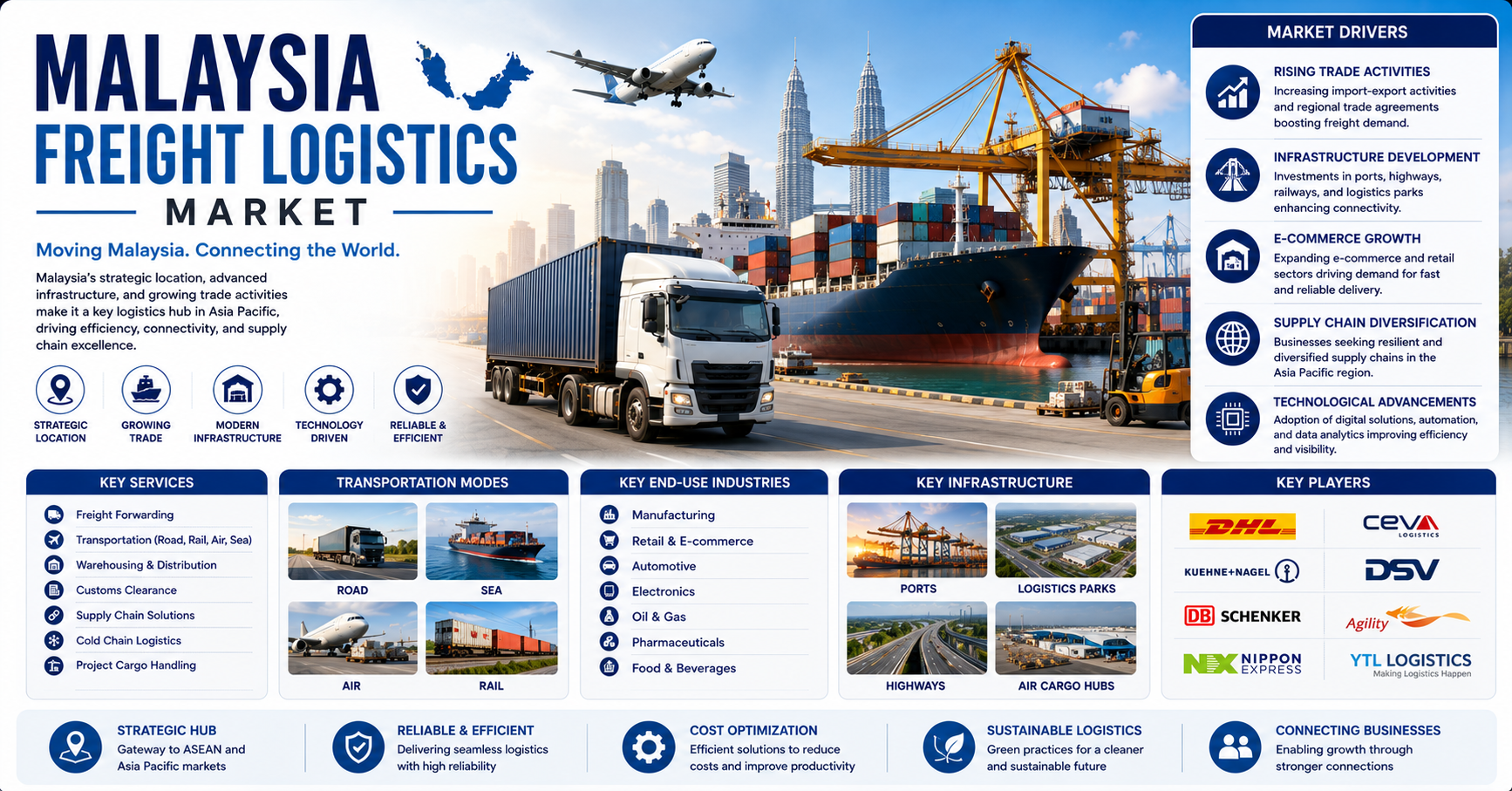
Malaysia Freight Logistics Market (2026 - 2035)
The Southern Region is the fastest-growing corridor with a projected CAGR of 6.35%, bolstered by new cross-border infrastructure with Singapore.
JOHOR, MALAYSIA, July 28, 2026 /EINPresswire.com/ -- Malaysia's freight logistics market reached an estimated USD 31.74 billion in 2025 and is projected to climb to USD 33.49 billion in 2026, before reaching USD 54.30 billion by 2035. That represents a compound annual growth rate (CAGR) of 5.52% across the 2026–2035 forecast period.Two structural forces are driving this expansion. First, Port Klang's emergence as one of the world's busiest container terminals is pulling in new cross-border forwarding and warehousing demand. Second, foreign direct investment flowing into Malaysian manufacturing — which topped MYR 400 billion, or roughly USD 88 billion, in approved projects during 2024 — is generating recurring freight volume tied to new production facilities.
Government policy is reinforcing the trend. The National Transport Policy 2019–2030, paired with diesel subsidy restructuring, has reduced cost volatility for haulage operators. Separately, more than MYR 9 billion has gone into the East Coast Rail Link, a rail project expected to cut freight transit time between Kuantan Port and Port Klang by roughly 50% once complete, creating a direct land bridge between the South China Sea coast and the Strait of Malacca.
Get Report Sample Copy with TOC: https://www.marketresearchfuture.com/sample_request/21318
Market Segmentation
By Logistics Function
Freight transport is the largest function in the market, holding a 51.2% share in 2025 and reflecting the dominance of road and sea freight in domestic and regional cargo movement. Road haulage alone handles around 55% of total freight tonnage, while sea freight connects peninsular ports to Sabah and Sarawak through cabotage services. Freight forwarding, valued at roughly USD 6.55 billion in 2025, is driven largely by cross-border trade facilitated under RCEP. Warehousing and storage, worth about USD 3.22 billion in 2025, is expanding on the back of cold-chain and bonded-facility growth. Other services, including customs brokerage and cargo insurance, are forecast to grow at a 4.85% CAGR.
Courier, express, and parcel services represent the fastest-evolving function, forecast to expand at a 6.30% CAGR through 2035 as e-commerce penetration deepens. Domestic parcel volumes exceeded 1.8 billion pieces in 2024, up 22% from 2022, as major parcel operators expanded automated sorting capacity to meet rising last-mile demand.
By End-User Industry
Manufacturing is the dominant end-user industry, accounting for 42.1% of the market in 2025. This reflects Malaysia's position as a major global hub for semiconductor packaging and testing, where fabrication plants require just-in-time inbound chemical shipments alongside climate-controlled outbound shipments of finished components. Wholesale and retail trade is forecast to grow at a 5.90% CAGR as modern retail formats and direct-to-consumer fulfillment models expand. Oil and gas, mining, and quarrying activity was valued at about USD 3.74 billion in 2025, driven by upstream extraction and LNG transport needs. Construction-related freight is projected to grow at a 5.35% CAGR, tied to infrastructure megaprojects, while agriculture, fishing, and forestry — anchored by palm oil, rubber, and aquaculture exports — was valued at roughly USD 2.15 billion in 2025. Other end uses, including government and defense logistics, are expected to grow at a 4.70% CAGR.
By Freight Transport Mode
Road freight holds the largest share of transport modes at 55.2% in 2025, underpinned by the peninsula's more than 2,400 kilometers of tolled expressways, which offer flexibility across varied cargo types. Sea freight was valued at about USD 8.95 billion in 2025, driven by containerized import and export volumes. Rail freight is forecast to grow at a 5.75% CAGR as East Coast Rail Link capacity comes online. Air freight, while a small share of total tonnage, is the fastest-growing mode at a projected 7.00% CAGR, as semiconductor and pharmaceutical shippers increasingly prioritize speed and traceability over cost.
Purchase Copy: https://www.marketresearchfuture.com/checkout?currency=one_user-USD&report_id=21318
Regional Market Share
Because this is a single-country market, its regional breakdown reflects Malaysia's domestic economic zones rather than separate countries. The Central Region, comprising Selangor, Kuala Lumpur, and Putrajaya, holds the largest share at 44.6% in 2025, anchored by Port Klang modernization and KLIA's cargo facilities. The Southern Region, covering Johor, Melaka, and Negeri Sembilan, holds 22.1% of the market and is being reshaped by the Johor–Singapore Special Economic Zone and the expansion of Tanjung Pelepas port. The Northern Region — Penang, Perak, Kedah, and Perlis — accounts for 16.3%, driven by semiconductor logistics and Penang port upgrades. The East Coast Region, spanning Pahang, Terengganu, and Kelantan, holds 9.2%, tied to the ECRL corridor and petrochemical freight. East Malaysia, comprising Sabah, Sarawak, and Labuan, rounds out the market with a 7.8% share, supported by palm oil export infrastructure and cross-border trade.
Within the Central Region, Selangor alone generated an estimated USD 10.85 billion in freight logistics activity in 2025, driven by Port Klang's container volumes — the port handled over 14.2 million TEUs in 2024. Kuala Lumpur is expanding at a 5.62% CAGR on the back of e-commerce fulfillment hubs, while Putrajaya and Cyberjaya contributed roughly USD 0.42 billion, tied to government and IT-related cargo. KLIA's air cargo terminal processed 780,000 tonnes in 2024, and Port Klang's free-trade zone hosts 340 licensed forwarding agents.
In the Southern Region, Johor is growing at a 6.35% CAGR, propelled by the Johor–Singapore Special Economic Zone formalized in January 2025 — an initiative expected to create over 100,000 jobs and draw around MYR 60 billion in incremental investment into logistics parks, bonded warehouses, and intermodal terminals. Melaka contributed about USD 1.10 billion, linked to tourism and F&B distribution, while Negeri Sembilan is growing at a 5.80% CAGR thanks to EV battery factory logistics.
In the Northern Region, Penang accounts for 38.4% of the region's freight share, driven by electronics manufacturing exports from facilities operated by major chipmakers. Perak generated roughly USD 1.24 billion, tied to agricultural and mineral freight, while Kedah and Perlis are growing at a 5.25% CAGR on rice-belt and Langkawi-related trade.
In the East Coast Region, Pahang, home to the ECRL terminus and Kuantan Port, generated about USD 1.72 billion in 2025. Kuantan Port's deep-water expansion, a joint venture with a Chinese consortium, lifted annual handling capacity to 52 million metric tonnes. Terengganu is growing at a 5.45% CAGR, driven by petrochemical cargo, while Kelantan generated roughly USD 0.48 billion tied to cross-border trade with Thailand.
In East Malaysia, Sabah is growing at a 5.15% CAGR on palm oil and timber exports. Sarawak contributed about USD 1.40 billion, linked to LNG and industrial cargo, while Labuan is expanding at a 4.80% CAGR as an offshore oil and gas supply base. Sarawak's Hydrogen Economy Action Plan, targeting green hydrogen exports by 2028, could introduce an entirely new freight category to the market.
Growth Drivers
E-commerce and last-mile demand represents the single largest growth driver, estimated to add 1.10 percentage points to the CAGR nationwide over the short term. Malaysia's e-commerce gross merchandise value exceeded USD 15 billion in 2024, growing roughly 18% annually. This has forced courier operators to build micro-fulfillment nodes in secondary cities such as Ipoh, Kuching, and Kota Kinabalu, with major e-commerce platforms' logistics arms investing more than MYR 1.2 billion in automated sorting centers since 2023.
ECRL and rail infrastructure investment is expected to contribute an additional 0.85 percentage points to CAGR over the long term, concentrated in the Central and East Coast regions. Valued at roughly MYR 50 billion, the East Coast Rail Link is Malaysia's largest transport infrastructure investment in two decades. Once complete, the 665-kilometer dual-track line is expected to move an estimated 53 million tons of freight annually between the east coast and Port Klang.
Foreign direct investment in manufacturing is projected to add 0.75 percentage points to CAGR over the medium term, concentrated in the Central and Northern regions. Malaysia approved manufacturing investments exceeding MYR 155 billion in 2024, with semiconductor and electrical-electronics projects making up nearly 40% of that total.
RCEP and CPTPP tariff liberalization is expected to add 0.60 percentage points to CAGR nationwide over the medium term. RCEP eliminated tariffs on more than 90% of intra-member goods categories, expanding Malaysia's preferential access to 26 economies representing a combined USD 30 trillion in GDP. Forwarding volumes tied to RCEP origin declarations grew 14% in 2024.
Report Summary: https://www.marketresearchfuture.com/reports/malaysia-freight-logistics-market-21318
Competitive Landscape
The market is highly fragmented, with an estimated Herfindahl-Hirschman Index below 500 and the top five players collectively holding only 20–28% of total revenue. DHL Supply Chain Malaysia holds an estimated 5–8% revenue share, positioned as a global integrator with deep local warehousing, contract logistics, e-commerce fulfillment, and cold-chain capabilities. Pos Logistics Berhad holds roughly 4–7%, leveraging its national postal legacy to diversify into domestic haulage, last-mile delivery, and warehousing. GDEX Berhad, with an estimated 3–5% share, positions itself as a technology-led express parcel and cross-border CEP specialist. Tiong Nam Logistics Holdings, also holding around 3–5%, operates as the largest domestic fleet operator with strength in warehousing, trucking, and container haulage.
CJ Century Logistics Holdings, a Korean-Malaysian joint venture with an FMCG focus, holds an estimated 2–4% share in freight forwarding and integrated logistics. Freight Management Holdings, a niche forwarder based in Penang, holds a similar 2–4% share across sea and air forwarding and customs brokerage. Nippon Express Malaysia and DB Schenker Malaysia each hold an estimated 2–3%, the former aligned with Japanese OEM automotive supply chains and the latter serving a European industrial client base through contract logistics and air and ocean freight. Kuehne + Nagel Malaysia and Kerry Logistics Malaysia round out the top ten with estimated shares of 1–3% each, the former known for its global network and perishable-goods expertise, and the latter for its Asia-focused strength in RCEP trade corridors.
Recent Industry Developments
In August 2025, DHL Global Forwarding opened a 38,000-square-foot dual-certified pharmaceutical cold-chain facility at KLIA's Free Commercial Zone. In October 2024, City-Link Express installed solar roofing, added three electric vehicles, and introduced biodegradable packaging as part of its ESG initiatives. In September 2024, FedEx and the Penang Development Corporation signed a memorandum of understanding for a MYR 46 million, or roughly USD 10 million, logistics facility at Penang International Logistics Aeropark. In August 2024, UPS and Ninja Van began offering UPS Worldwide Express and Express Saver services across 52 Malaysian locations.
Related Report
Freight and Logistics Market https://www.marketresearchfuture.com/reports/freight-and-logistics-market-8698
digital freight forwarding market https://www.marketresearchfuture.com/reports/digital-freight-forwarding-market-22835
India Road Freight Transport Market https://www.marketresearchfuture.com/reports/india-road-freight-transport-market-21346
Maritime Freight Transport Market https://www.marketresearchfuture.com/reports/maritime-freight-transport-market-11581
intermodal freight transportation market https://www.marketresearchfuture.com/reports/intermodal-freight-transportation-market-42913
Market Research Future
Market Research Future
+1 855-661-4441
email us here
Legal Disclaimer:
EIN Presswire provides this news content "as is" without warranty of any kind. We do not accept any responsibility or liability for the accuracy, content, images, videos, licenses, completeness, legality, or reliability of the information contained in this article. If you have any complaints or copyright issues related to this article, kindly contact the author above.
